
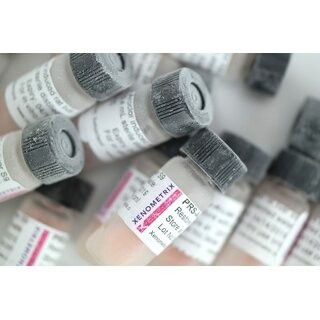
Post-Mitochondrial Supernatant S9 Fraction from PB/?-Naphtoflavone induced rat liver
產品應用
Due to bacteria being unable to metabolize molecules, the mutagenic potential of samples is assessed directly and in the presence of metabolic activation system: Microsomal fraction S9 of Phenobarbital/ß-Naphtoflavone induced rat liver homogenate. Rat liver S9 is used in the Ames Test (OECD 471), in vitro Micronucleus Test (MNvit, OECD 487) and in Chromosomal Aberration Test (OECD 473) for chemicals, xenobiotics, herbicides, pesticides, biocides, cosmetics, pharmaceutical preparations or soil, waste water.
Phenobarbital/ß-Naphtoflavone induced hepatic S9 after reconstitution is a buffered solution containing the post mitochondrial S9 fraction of a pool of livers from male SpragueDawley rats. Liver S9 fractions (the 9000g supernatant of a liver homogenate) contain both microsomal and cytosolic fractions. S9 fraction includes many cytosolic enzymes: N-acetyl transferases, methyltransferases, sulfotransferases, glutathione transferases, aldehyde oxidase, xanthine oxidase. Both Phase I (Cytochrome P450-Monooxigenases) and Phase II metabolites act simultaneously on test samples. Due to the fact that the enzymes in the S9 fractions are diluted significantly, cofactors such as e.g. β-Nicotinamide adenine dinucleotide phosphate-regenerating system (NADPH, Phase I oxidation) are required for activity. Cofactors are added to the S9 preparation before the experiment (S9 Cofactor Kit, art.no. PCO-0800).
Characteristics
- High quality of lyophilized S9 with comparable activity to frozen rat liver S9 (see attachment below)
- Protein Concentration: 25 - 35 mg/ml
- Storage: -20 or -80 oC
- Shipment: with Cool Blocks from external storage in Germany or from Switzerland
- Shelf Life: 12 -36 months
- S9 is quality controlled in all strains available from Xenometrix: TA98, TA100, TA1535, TA1537, E.coli uvrA(pKM101), E.coli Combo (E.coli uvrA combined with E.coli pKM101)^, please see Certificate of Analysis below
- In full compliance with OECD 471 guideline, ICH M7, OECD 487, OECD 473, ISO13449.
- Requested volumes in different Ames test: 0.44 mL/strain/compound in MicroAmes24, 0.35 mL/strain/ compound in Ames MPF, 1.4 mL / strain/ compound in Ames agar plate Test
- Can also be used for micronucleus test (MNvit) and Chromosomal Aberration Test
- Is also included in all in one Ames MPF kits
相關產品
Ames II - 10 Sample Kit for Ames Test with 2 Strains
Xenometrix
品號:E10-213-S2-P規格:kit了解更多 >>Ames MPF 98/100 - 1 Sample Kit for Ames Test with 2 Strains (incl. PB/NF induced S9 and positive controls)
Xenometrix
品號:A01-210-S2-P規格:kit了解更多 >>Ames MPF Penta 1 - 1 Sample Ames Test Kit with 5 Strains
Xenometrix
品號:C01-512-S2-P規格:kit了解更多 >>MicroAmes24 - 98/100 Ready to use Ames Test Kit in 24 Well Agar Plate
Xenometrix
品號:D05-210規格:kit了解更多 >>